
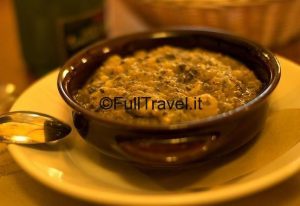
Ribollita, a typical dish from the Tuscan tradition
The name ribollita comes from the fact that the most common vegetable soup, leftover from previous days, was then strengthened by adding beans, black cabbage, stale bread, and "reboiled" by heating it again in the traditional earthenware pot.
Equipment
- Large deep pot (for cooking the soup)
- Bowls (for soaking and mixing)
- Wooden spoon (for stirring during cooking)
- Immersion blender (for blending part of the beans, if desired)
- Terracotta pot or thick-bottomed pan (optional, for traditional "rebollitura")
Ingredients
- bread stale tuscan bread
- 300 gr black cabbage Tuscany curly kale
- 300 gr savoy cabbage
- 1 kg cannellini beans pre-cooked
- 4/5 nr tomatoes pre-cooked
- 1/2 nr potatoes
- qb carrots
- qb celery
- qb onion
- qb parsley
- qb pepper black
- qb thyme
- qb salt
- qb Extra Virgin Olive Oil
- qb Sage
- qb Rosemary
- qb Garlic
- 3 nr Chili pepper
- 2 nr Vegetable bouillon cube
Instructions
- Cook the beans (if not pre-cooked, it takes 2-3 hours, important, in barely boiling water with 2 cloves of garlic, a sprig of sage, and a splash of olive oil, salt.
- Meanwhile, clean the black cabbage and remove the tough central stalks. Chop the leaves with the savoy cabbage, and slice the zucchini.
- Blend together 3 cloves of garlic, half an onion, 4-5 sage leaves, a sprig of rosemary, 3 chili peppers, 2 vegetable or mushroom bouillon cubes, and some water.
- Make a chopped mixture with onion and fresh herbs and sauté it in a large pot with plenty of oil, after adding the vegetables from step b for one minute (the bottom of the pot should be well coated, extra-virgin olive oil strongly recommended, avoid seed oils!). Cook for 3 minutes on high heat, almost sticking.
- Add the cabbages, lower the heat, cover, and stir occasionally for 10-15 minutes. Add the peeled tomatoes, stir, cover, and wait 10 minutes.
- Pass the beans, garlic, and sage leaves through a blender to make a very liquid mash, leaving about one-third aside, then add to the pot, adjusting with some of the bean broth if necessary. Season with salt if needed.
- Wait about 30 minutes. Slice the bread into about 1 cm thick slices, place in a wide dish or pan, coated with oil, and soak with the vegetable broth, adding the beans set aside.
- Add another layer of bread, then the broth again, and repeat to cover all the vegetables. Keep some broth aside to prevent the dish from becoming too dry once the bread has soaked up the liquid.
- Let it cool down. Refrigerate (covered) for a day. Now you might ask: why is it called "ribollita"? The genius of the grandparents was all in leaving that which is mainly a bread soup to rest for a day or at least a few hours.
- Next day (or after a few hours), reheat everything on moderate heat, stirring constantly until it becomes a fairly homogeneous "blob".
- In just a few minutes, serve with a crispy crust on the bottom, enhancing the flavors crafted over fire, with a drizzle of oil and a grind of pepper.
Notes
1. The weight of ingredients is indicative... trust your instinct and you won't go wrong!
2. I recommend cleaning the black cabbage with your hands, holding the stalk from the root and freeing the tender part by stripping each leaf from the tougher stalk until the tip... works great. Use the inner, more tender stalks entirely.
3. Use two tablespoons of concentrated tomato paste instead of peeled tomatoes for a more brownish color typical of ribollita.