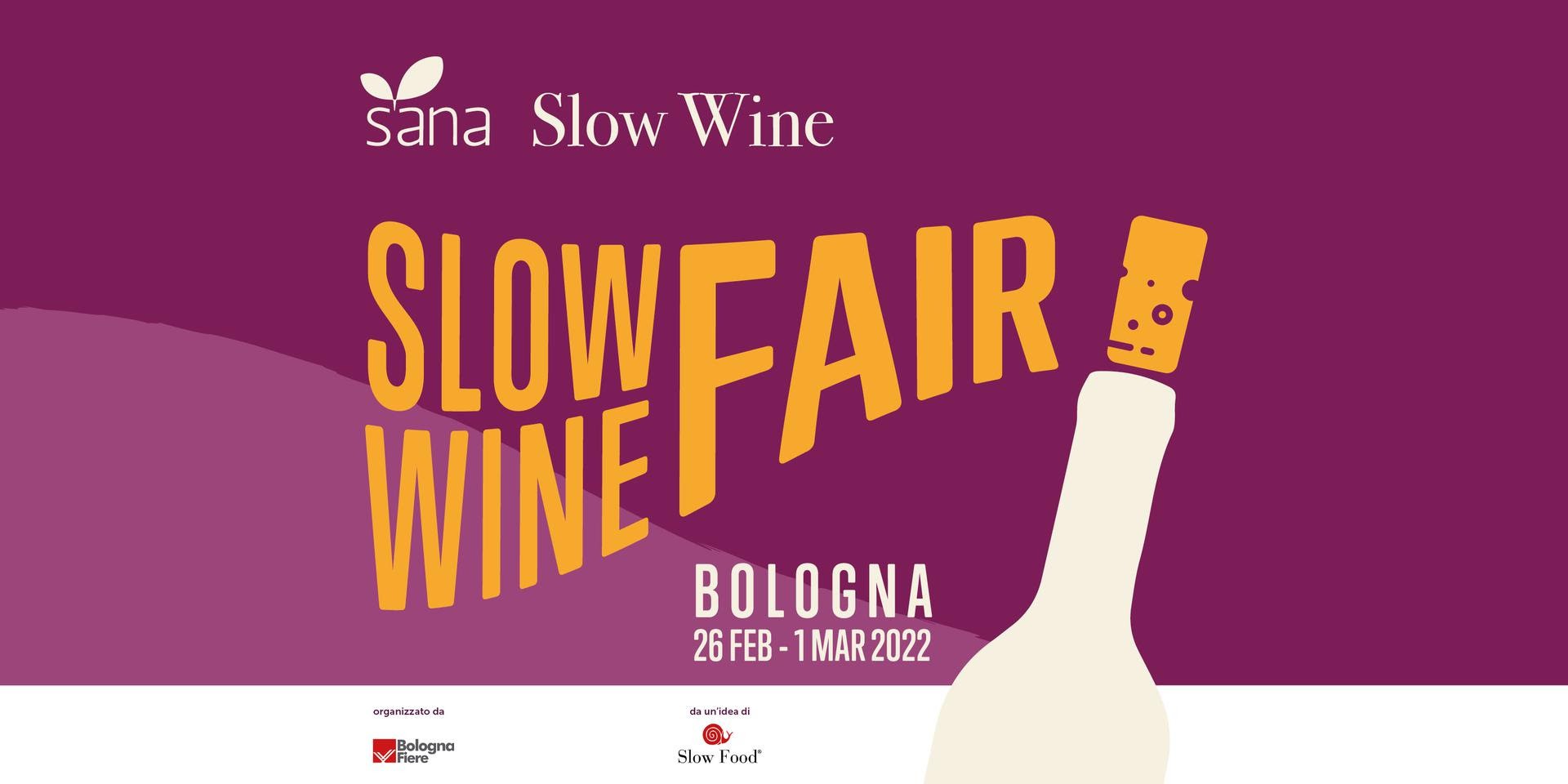

Sana Slow Wine Fair, the international event dedicated to good, clean and fair wine, organized by BolognaFiere, with the artistic direction of Slow Food, in collaboration with Società Excellence and with the participation of FederBio is scheduled to take place in Bologna from February 26 to March 1, 2022.
There will be producers from every corner of Italy (and that’s not just a saying: all regions and autonomous provinces will really be there!) and hundreds of foreign realities. Wineries from Albania, Argentina, Armenia, Austria, Bosnia, Brazil, Bulgaria, Chile, Croatia, France, Germany, Macedonia, Montenegro, the Netherlands, Peru, Portugal, the United Kingdom, Romania, Slovakia, Slovenia, Spain, the United States, and South Africa have already said yes.
A world tour to the sound of great wines. But not just any great wines, rather labels (the catalog already counts over 3700, and here we have listed them all, and the number will rise to 5000) that respond to three clear principles, the same that guide the Slow Wine Coalition and are written in the Slow Food Manifesto for a good, clean and fair wine: these are environmental sustainability, landscape protection, and the cultural and social role that wineries can play in the territories where they operate.
These three values represent the guidelines used in the selection of wineries present at the Bologna fair. Those who participate in the four-day event in Emilia will see firsthand what we mean, but in the meantime, we believe it can be useful to hear it in the words of the producers.
Three values for the guidelines
Environmental sustainability
Respecting the environment means, among other things, saying no to chemicals in agriculture: no herbicides, in other words. Paraschos is a winery located between San Floriano del Collio and Olsavia (Gorizia), in Friuli-Venezia Giulia. Today, the company is led by Alexis and Jannis, sons of the founder Evangelos, who came from the Greek city of Thessaloniki to study at the University of Trieste. “Dad started taking an interest in wine because he was fascinated by the farmers and vine growers of Collio who, in the seventies and eighties, worked the land with respect and would never have dreamed of introducing herbicides into the vineyards,” Alexis told us. “They transmitted to him that love for the land that makes you want to pass it on to your children and not just exploit it. For us, organic, sustainable, ecological agriculture came first, and then wine.”
Environmental sustainability also means biodiversity above all: it is the richness of plant varieties from which the soil feeds, enriching itself and then passing on such qualities to the fruits. This is also the thinking at Agricola Felline, a company in Manduria (Taranto) that cultivates Primitivo… and more: “We try to let the spontaneous vegetation that often grows on our dry stone walls develop,” owner Gregory Perucci explained. “In this way, the vineyards become a living habitat for a diversified flora and fauna: fruits, flowers, herbs, and vegetables thrive on living soils… The vineyard is also home to butterflies, birds, insects, reptiles, and countless soil organisms. This interaction guarantees a stable, largely self-regulating ecosystem, which we believe brings genuine balance and terroir quality.”
Using clean energy and reducing waste is another aspect to consider in the environmental assessment of a business, as Lorenzo Marotti Campi, son of the founders of the homonymous winery in Morro d’Alba, in the province of Ancona, reminded us: “Our winery has a solar system that allows us to achieve almost total energy independence.”
Social impact: being fair
Another important aspect concerns the human sustainability of the company: “We pay salaries above average because we need to establish long-term and trusting relationships with the people we work with,” Lorenzo Marotti Campi added.
Jill and Steve Matthiasson, from the eponymous Matthiasson winery in Napa, California, also work respecting this principle: “We do not hire seasonal workers,” Steve explained to us, “all our 17 employees have stable and long-term jobs. We deliberately designed our business this way, and it helps that we have several vineyards with different grape varieties ripening at different times.” And even when unforeseen events upset the routine, the entrepreneurial couple found ways to get through: “About two-thirds of our sales depend on restaurants and so when the Covid-19 pandemic exploded and restaurants closed, our sales stopped. We shifted as quickly as possible to guided tastings on Zoom, and fortunately, our initiatives in this field were quickly picked up and reviewed by national magazines. This saved our business.”
Landscape protection
The third principle that guides the Slow Wine Coalition, and consequently the Sana Slow Wine Fair which represents its first international event, concerns the defense of the beauty of the landscape. The vine is the crop that more than any other contributes to defining the aspect of the hilly and pre-hilly areas, and for this reason, it is essential that vine growers take care of it. “Our father worked as an agronomist for many years, he conveyed to us the passion and dedication for the vineyard, and thanks to him and our grandparents, we grew up in contact with nature,” Maria Rosa Bordini told us, who, together with her sister Enrica and brothers Enrico and Giampaolo, inherited the Villa Papiano estate in Modigliano (Forlì-Cesena) founded by their father Remigio. “For years we dreamed of building a life project together focused on nature and the vineyard. In 2000 we found this perfect place, with an ecosystem capable of conveying this uniqueness also in the wine we produce.” A terrestrial paradise nestled in the Tuscan-Romagna Apennines, a treasure to preserve and protect also by making it productive. Provided it is respectful production.
On the event’s website, new stories of producers participating in the Sana Slow Wine Fair 2022 are published every week: for example, that of Marco Minnucci, who moved from Lake Maggiore to Costigliole d’Asti, or those of producers from abroad. There is the case of Slow Wine Latam, the network for good, clean and fair wine that brings together Latin American vine growers, and producers who are part of the Slow Food Presidio of the Roter Veltliner in Austria.