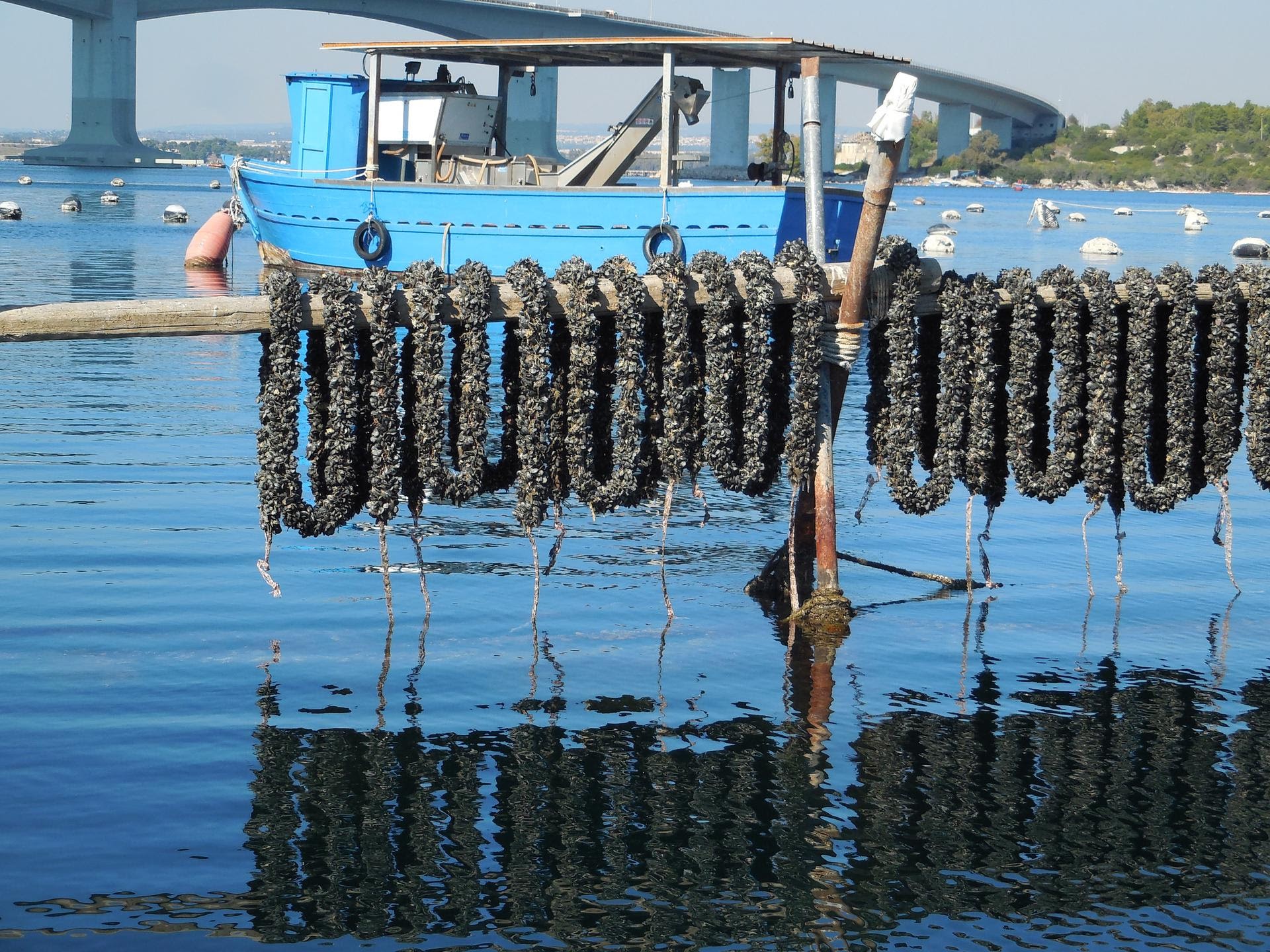

The black mussel of Taranto is a new Slow Food Presidia and it is also much more: first of all a recognition that challenges the prejudices that for years, mainly for environmental reasons, have afflicted the Apulian city, and also a symbol of rebirth for a community that has mussel farming at the roots of its history.
The Mar Piccolo, kingdom of the Taranto mussel
If Taranto rhymes with shellfish farming, the credit goes to unique environmental conditions: «We are talking about the Mar Piccolo, an inland body of water that is a very particular ecosystem, characterized by the presence of 34 underground freshwater springs coming from the Murge hills that flow into it – explains Luciano Carriero, representative of the Presidia producers –. It is precisely due to this constant supply of freshwater that the extraordinary sweetness of the black mussels of Taranto is achieved: these sources, in fact, besides perfect thermoregulation, ensure control of the water’s salinity».
But the benefits are mutual: if the mussels have found here the ideal habitat to develop, they themselves act as a “filter” for the water: «If today the mussels disappeared from the Mar Piccolo, the ecosystem would change radically – explains Marco Dadamo, director of the Palude Vela regional nature reserve of Taranto and member of the Slow Fish Advisory Board, who collaborated on the development of the Presidia –. They are an important element that contributes to maintaining the high resilience of the environment by providing important ecosystem services such as recycling excess nutrients present in the water column».
This is why, for Carriero, the recognition as a Slow Food Presidia is «the occasion to relaunch a sector that has lived through a period of crisis for unjust reasons. We work in very tightly controlled waters – he continues – but unfortunately Taranto is only talked about for environmental pollution. This image has penalized us, even though we work in an extraordinary natural oasis».

Mussel farming in Taranto dates back to the 16th century
Mussel farming in Taranto is a very serious and ancient matter: the first documents referring to black mussels date back to 1525, and already in the 16th century the Taranto rulers put precise rules in writing to avoid overexploitation of the coastal lagoons. And for centuries it was so, at least until the last decades of the last century when, alongside the city’s industrial development, shellfish farming also suffered the effects of technological progress. Emblematic, from this point of view, is the discussion about materials: with the development of plastic, for some time the farmers abandoned nets made of natural materials, preferring synthetic ones, easily obtained and low cost.
But in this way, those same materials became a threat to the marine ecosystem: «Years ago, before the reclamation of the Mar Piccolo started, there was a layer of plastic nets on the seabed, thick in some places even several centimeters» recalls Marcello Longo, president of Slow Food Puglia, who worked on the launch of the Presidia for more than four years. «Thanks to collaboration with scientific partners, such as the CNR, and technicians, like Novamont, the producers adhering to the Presidia have instead resumed using eco-sustainable materials, made of mater-bi and therefore compostable». The goal, besides avoiding the risk of marine littering, i.e. the release of waste into the water, is to start a circular economy path so that nets, once their function is exhausted, become useful compost for the green and agricultural areas of Taranto.

The numbers of the Slow Food Presidia of Taranto
The mussel farmers involved in the project, whose disciplinary strictly defines production methods, are currently 21, mostly children and grandchildren of farmers who have practiced this job for years. Requests for membership continue to grow though: a sign of the will to leave behind the image that for too many years has accompanied Taranto, reclaiming that historical vocation linked to the sea and its excellences. «In this Presidia there is a lot of social justice – continues Longo – and thanks to this project we give dignity back to the farmers: the mussel farmers, for their part, are happy because together with Slow Food they know they can work better».
Among the producers who adhere to the Presidia is also Francesco Marangione. “I farm mussels for love – he says –: love of the sea, of dawns and sunsets, of freedom. When the sea gets into your veins, it’s hard for it to leave: for me this happened as a boy, when I started helping my father. Slow Food? It is a ray of light and hope.”
“This is a special Presidia, going far beyond the product – concludes Serena Milano, director of Slow Food Italy –. It is a bet on the future of this city. Together with the mussel farmers, Taranto looks at its most important resource, the sea, and brings together respect for the environment and respect for labor, culture and the knowledge of many generations. An important challenge that, if won here, in such a complex context, can become an example and a symbol for many other areas in Italy.”