
Eating alone is no longer a marginal behavior. The latest data released by Circana show that the so-called solo dining is becoming an increasingly significant component of food consumption, both at home and away from home. This change affects not only individual habits but can have concrete consequences for restaurants, chains, food retail, and industry operators.
The data: half of main meals at home are eaten alone
According to the latest report Eating Patterns in America by Circana, 50% of main meals consumed at home in the United States are now eaten alone. This figure has grown by two points compared to the previous year and by four points since 2021. The phenomenon spans various times of the day. 59% of domestic breakfasts are consumed individually, nearly six out of ten lunches are eaten alone, and 65% of snacks occur without company.
So this is not behavior confined to a specific time slot or consumption occasion. Solo dining fits into a broader change linked to work mobility, the search for simplicity, the reduction in average family size, and the increase in adult consumers with greater spending power.
The single customer is also growing in restaurants
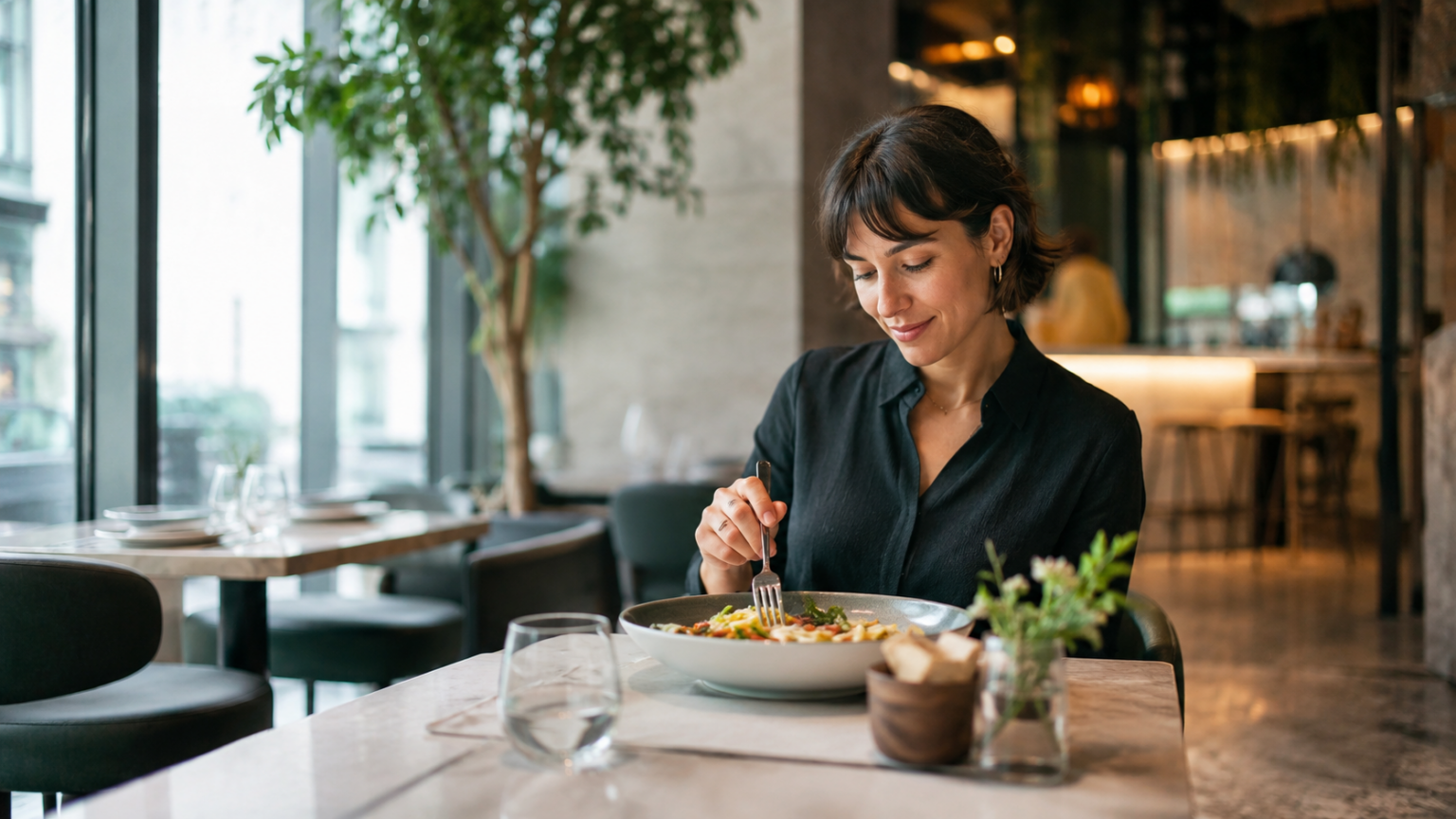
The most interesting data for the restaurant sector concerns out-of-home consumption. CREST analyses by Circana show that in the past year, individual consumption occasions in public establishments have increased, while those with two or more people have decreased. The reduction in average group size is particularly evident in full-service restaurants: in the first quarter of 2026, solo visits represented 23% of the total.
The phenomenon is even more pronounced in the earlier part of the day. Individual consumption occasions make up 59% of breakfasts outside the home, while snacking also sees a strong prevalence of solo visits.
Solo dining does not necessarily mean loneliness
For the restaurant industry, it would be a mistake to automatically interpret the solo customer as an isolated person or an exceptional situation. The economic point is different: the unit of consumption is changing. For decades, many restaurant models have been built around couples, families, or groups. Tables for two or four, portions designed to be shared, promotional offers aimed at multiple diners, and spaces designed around socializing are still very common elements. But as the share of solo diners grows, the way operators must design the experience also changes.
What changes for restaurants
The first issue concerns space. A single customer occupying a table for four can be perceived as inefficient during peak hours. But the response cannot simply be to penalize the individual customer. Bar seating, counters, small tables, shared seating, and more flexible areas can help manage demand better without compromising comfort.
The second issue concerns the menu. Solo dining makes the availability of individual portions, quick options, complete dishes, and easy-to-order proposals without needing to share more important. According to Circana, flexibility, portability, and portion size are some of the elements where retailers and foodservice operators can work to better catch this emerging behavior.
Speed and simplicity become part of the experience
The data also show how important the time factor is. Almost two-thirds of breakfasts consumed at home and over half of lunches are prepared in less than five minutes. The need for simplicity driving home consumption can also be reflected in expectations of dining out.
For this reason, the solo customer can be particularly sensitive to fast service, the ability to order without waiting, menu clarity, and ease of payment. This does not necessarily mean focusing solely on fast food. Even a traditional restaurant can offer an efficient and pleasant experience to those who choose to eat alone.
A signal also coming from travel dining
The trend finds confirmation in other restaurant segments as well. OpenTable recorded a 30% year-over-year increase in individual bookings made by travelers at hotel restaurants and bars in 2026. Additionally, 71% of those surveyed state they would consider eating alone in a hotel restaurant or bar.
This is a particularly interesting signal as it shows how solo dining may be linked not only to daily habits but also to mobility, business travel, and individual tourism.
The risk: considering the solo customer a lost table
One of the main risks for operators is to continue considering the individual customer as a sort of anomaly. In reality, if the phenomenon keeps growing, the table for one can become a structural part of demand. A solo customer may have more flexibility in timing, be more available for last-minute bookings, and represent an interesting demand even in less crowded time slots.
OpenTable also reports that in 2026 consumer interest in spontaneous consumption occasions is rising, another factor that can favor the individual customer.
The real opportunity: making eating alone normal
The central issue is therefore not to create “restaurants for single people,” but to eliminate elements that make the solo customer’s experience uncomfortable or unnatural. Hospitality, table arrangement, menu, service times, and atmosphere can make a difference. For restaurateurs, solo dining can become an interesting area for experimentation: individual lunch formulas, small plates, counter seating, tasting menus designed also for one person, flexible reservations, and faster services.
A change in consumption to watch closely
The analyzed data mainly concerns the U.S. market and cannot be automatically transferred to the Italian reality. However, they represent a signal to observe carefully also in Europe, especially considering the growth of smaller family units, professional mobility, hybrid work, and individual travel.
The point for restaurants is simple: customers no longer necessarily arrive as couples or groups. And when the number of people seated at the table changes, so do service, menu, spaces, and potentially the economic model of the venue.
Source: Circana data, Eating Patterns in America and CREST, August 2026; OpenTable data, 2026 Dining Trends and Travel & Dining Trends.