
In the food sector, the label is one of the most important elements of a packaged product. Even before tasting, before the final choice, and often before knowing the brand, it is the label that creates the first contact between the company and the customer. This applies to an artisanal preserve, a bottle of oil, a beer, a jar of honey, a jam, a baked good, or a gastronomic line intended for distribution.
For food producers, farms, artisanal workshops, and food & beverage operators, designing and printing adhesive labels does not only mean focusing on aesthetics. It means working on identity, readability, visual coherence, material durability, and production process organization.
In this context, online printing of labels for food products can become a practical solution to manage production, reordering, and adaptation of different product lines in a more orderly way.
Why the label matters in food & beverage
A packaged food product communicates through many details: the name, the logo, the colors, the container’s material, the packaging shape, and the overall tone of the brand. The label ties all these elements together and makes them immediately recognizable. For a food company, a good label must be clear, readable, and consistent with the product’s positioning. A high-end extra virgin olive oil will have different visual needs compared to a ready-made sauce, a craft beer, or a line of preserves. The supports, finishes, type of container, and even how the product will be displayed or sold vary.
Therefore, the label must work both practically and narratively. It should help the buyer immediately understand what they have, but also convey care, reliability, and identity.
Online label printing for food products: when it’s useful for companies
For many players in the food sector, managing labels can become complex. Product lines increase, formats change, graphic variants are added, different packaging is used, and often multiple SKUs must be coordinated within tight timelines.
The online printing of labels for food products allows these steps to be handled in a more orderly flow, especially when the company already has clear specifications on format, material, graphics, and label use.
An online label printer like LabelDoo can be a reference point for B2B producers and operators looking for a configurable system that guides the selection among formats, materials, applications, and finishes. The interesting aspect for those working in food is the ability to set up the project based on the container and product image, maintaining control over the main printing parameters.
From container to material: every choice affects the result
The same graphic can look very different depending on the chosen support. A label intended for a bottle, a jar, a box, or flexible packaging must be designed considering the surface it will be applied to. In food & beverage, factors like humidity, low temperatures, frequent handling, transport, shelving, refrigerated counters, or storage often come into play. For this reason, the choice of material should not be left to the last moment. Paper, more robust supports, protective finishes, and special treatments can change the product perception and the label’s durability over time.
For an agricultural producer or an artisanal workshop, this step is particularly important. A well-printed, well-applied label consistent with the container enhances the product and helps make it look more professional to customers, retailers, and buyers.
Format, readability, and visual identity
The label’s size must be proportional to the packaging. A label that is too small may fail to enhance the product; one that is too large can overwhelm the container or make the whole presentation less elegant. Choosing between rectangular, oval, circular, or customized shapes depends on the packaging type and the message to be communicated.
Readability remains central. Too small fonts, weak contrasts, or cluttered designs can penalize even a quality product. In the food sector, where customers often compare similar products, a clear and orderly label helps facilitate their choice.
Visual identity, on the other hand, works on recognition. Colors, illustrations, textures, logos, and finishes must be consistent with the brand. A well-coordinated product line communicates solidity and makes it easier to stand out on shelves, specialized retail, e-commerce platforms, and catering supplies.
The role of finishes in food labels
Finishes can make a label more durable, more elegant, or more suited to the product type. Lamination, varnishing, hot stamping, embossing, or special die cuts are not just aesthetic details: they help define the packaging character. A premium product may require a more refined finish, while a daily line might aim for a clean, essential, and easily recognizable look. What matters is that the choice is consistent with the product’s positioning and its target audience.
In B2B, this aspect is even more relevant because the label must also function in relationships with distributors, stores, delicatessens, wine shops, restaurants, and other professional operators. A well-kept packaging simplifies commercial presentation and strengthens brand perception.
Organizing printing for lines, variants, and reorders
Those working in food rarely have only one product. More often, they manage different lines: flavors, sizes, seasonality, special SKUs, gift packages, or products aimed at different channels. For this reason, label printing should also be designed with internal organization in mind. Having organized files, coherent graphics, and repeatable printing parameters helps avoid errors and makes reordering easier. When a label works well, being able to reprint it while maintaining visual continuity is a tangible advantage.
Online printing, if supported by a clear configurator and technical assistance, can facilitate this work: placing an order, verifying file characteristics, choosing the most suitable material, and keeping a coherent logic across the company’s various labels.
Labels for artisanal food products
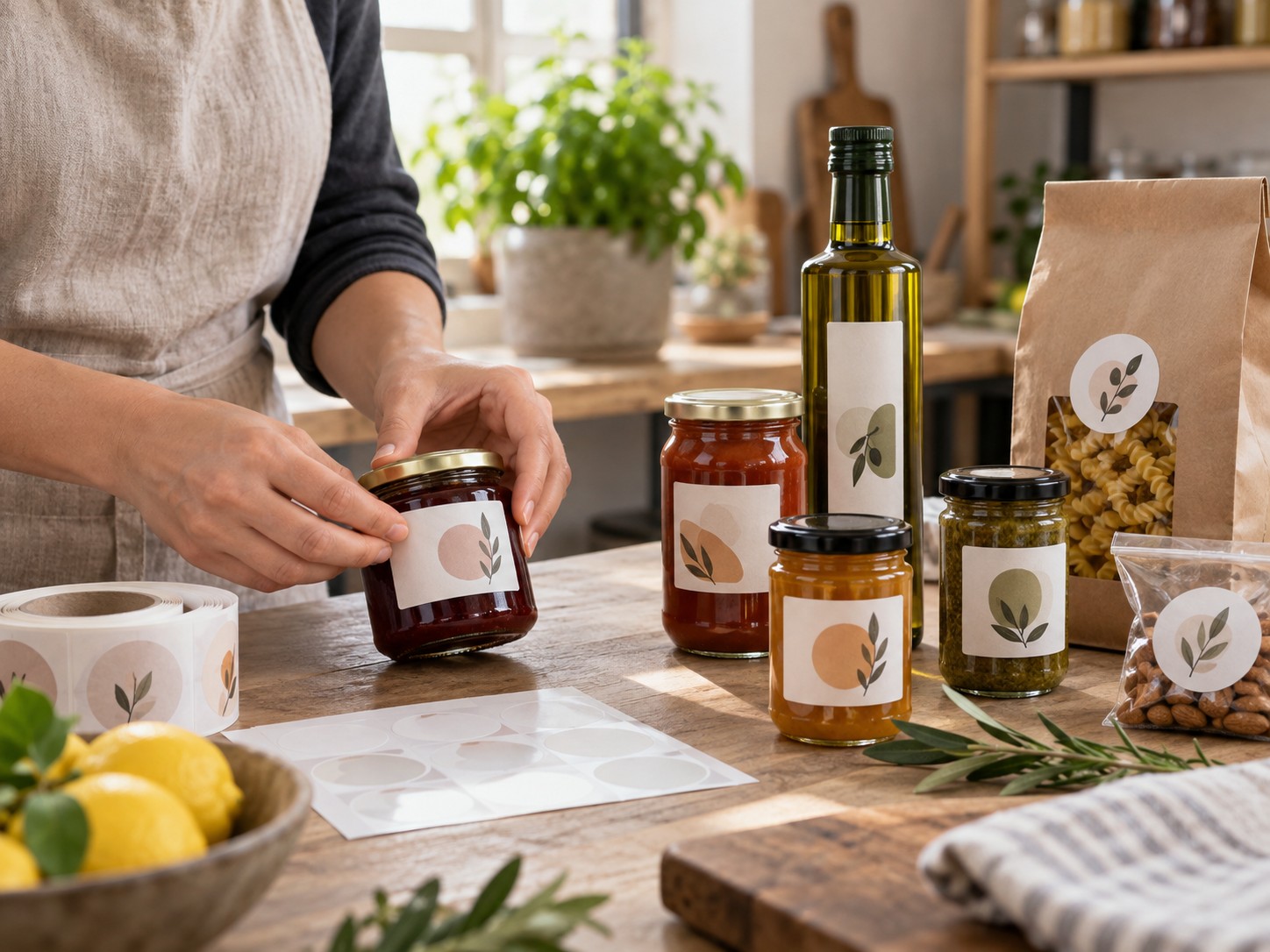
For artisanal food products, the label carries even greater value. It must not seem anonymous or improvised. It should tell the product’s character, the care in its crafting, and the company’s personality. A workshop producing jams, preserves, cookies, sauces, fresh pasta, or local specialties needs a label capable of conveying authenticity and reliability. The same applies to farms, oil mills, wineries, breweries, and local producers wanting to present a professional image even beyond their own territory.
Therefore, print quality becomes part of the experience. A well-designed graphic, printed on a suitable support and correctly applied, helps add value to the product even before purchase.
Conclusion
Online printing of adhesive labels for food products is a useful tool for companies wanting to manage packaging and product image with greater precision. It does not replace graphic design or brand strategy but can simplify the transition from graphic design to printed production. For food producers, farms, artisanal workshops, and food & beverage operators, choosing the right format, material, finish, and application method means protecting the product’s identity and improving its market presentation.
In a sector where perceived quality often passes through details, the label remains one of the most concrete tools to tell who produces, what is offered, and why that product deserves attention.