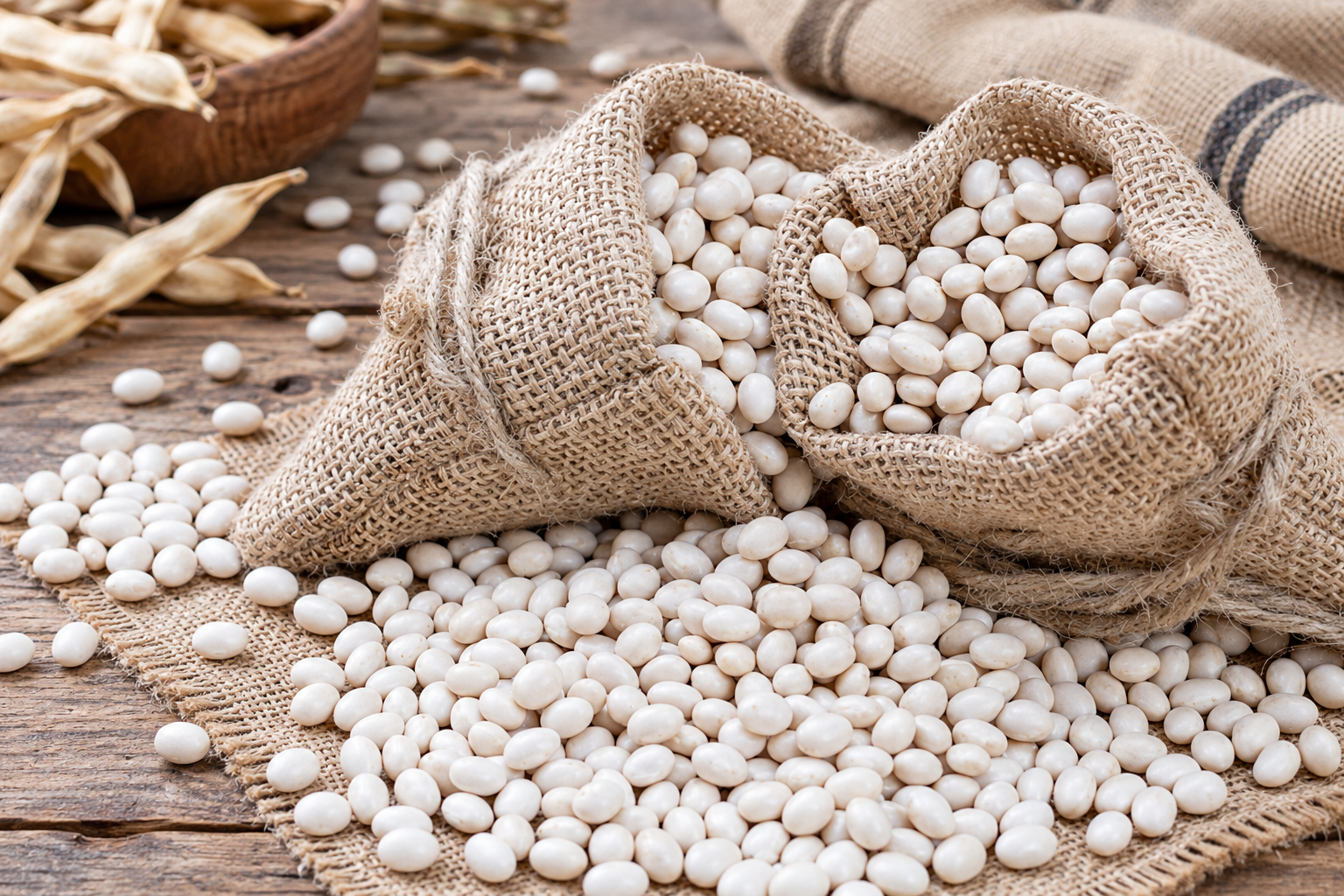

They have a thin skin, a uniform white color, and a history rooted in the peasant civilization of Basilicata. The Rotonda White Beans PDO are one of the most representative agricultural products of Pollino: a food that tells the story of the fertility of the Mercure Valley, the work of farmers, and a cuisine capable of transforming few ingredients into dishes rich in identity.
For generations, they have been an important resource in the diet of local families. They were grown in gardens and fields, consumed fresh during the season, and stored dry for the winter. Today, the Protected Designation of Origin safeguards this agricultural and gastronomic heritage, closely linked to southern Basilicata. In the same territory, another specialty is born: the Rotonda Red Eggplant PDO.
Rotonda White Beans: an ecotype of agricultural tradition
The designation includes the local ecotype of the species Phaseolus vulgaris L.: the White Poverello Bean. Therefore, it is not a generic name given to any light-colored bean. The PDO identifies products obtained in the delimited area and in accordance with a specific production specification.
Seed selection, continuity of cultivation, and the environmental conditions of the Mercure Valley have contributed to preserving these ecotypes. Distinctive characteristics include the white color of the seed, the absence of veins, and a particularly thin seed coat, almost imperceptible after cooking.
The protected product can be marketed in two forms: waxy pod waxy pod, harvested while still fresh, and dry seed, intended for storage and consumption throughout the year.
Where Rotonda White Beans PDO are produced
The production area is located in the Mercure Valley, on the Lucanian side of Pollino, and includes the irrigated district within the territories of four municipalities in the province of Potenza:
- Rotonda;
- Viggianello;
- Castelluccio Superiore;
- Castelluccio Inferiore.
The landscape is that of a valley surrounded by the Pollino mountains, with a geological history that has helped form fertile soils. The ancient lake basin of the Mercure Valley left alluvial deposits with sandy, silty, and clay components. The presence of water and the tradition of irrigation have supported the cultivation of vegetables and legumes over time.
For these beans, the relationship with the environment is not purely narrative: the specification links some of their qualities, including the thinness of the seed coat, to the characteristics of the soils and water availability.
A history crossing the nineteenth century
The cultivation of beans in the Mercure Valley has documented roots long before the European recognition. The historical sources cited in the specification describe an agricultural territory already known in the 1800s for its water supply and the variety of crops.
During his 1826 trip to Basilicata, the botanist Michele Tenore described the area’s water richness and the inhabitants’ ability to use it to irrigate fields. A publication from 1852 about the Kingdom of the Two Sicilies also mentioned the cultivation of various bean species: an indication of their role in the local agricultural economy.
These references help to understand the context in which the Rotonda ecotypes were selected. Legumes were not occasional products but essential ingredients in family diets, to be harvested during the warm season and stored for the colder months.
The curious testimony about Garibaldi’s passage
An event remembered by the specification links the local beans to the passage of Giuseppe Garibaldi in Rotonda in 1860. According to a testimony from theEcho of Basilicata Calabria Campania, published on September 2 of that year, Garibaldi tasted the white beans during his stop in the town and appreciated them so much that he took a small quantity with him to plant in Caprera.
The episode should be read as a historical testimony reported by a contemporary source, not as verification of the subsequent cultivation of the seeds on the island. It is nevertheless a significant story: it conveys the image of a product recognized for its qualities already in the second half of the nineteenth century and reminds us how seeds and agricultural knowledge traveled alongside people.
How they are made: waxy pod and dry seed
The production specification precisely defines the appearance and characteristics of the product marketed under the DOP name.
The waxy pod must appear fresh, healthy, and plump, with a color ranging from white to light yellow or ivory. It can reach a maximum length of 10 centimeters and a maximum width of 10 millimeters. For this type, a protein content of at least 9% on the product as is is required.
The dry seed instead has white seeds without veins and medium glossiness, with a cubic or rounded shape. The maximum dimensions are 10 millimeters in length and 9 millimeters in width; one hundred seeds can weigh up to 90 grams. The minimum protein content is 24% of the dry matter.
The feature that unites the two consumption forms is the particularly thin seed coat. After cooking, the outer seed coating is almost imperceptible: a quality that makes these beans interesting both in soups and in dishes where they must maintain a pleasant consistency.
Why the skin is so thin
The thin skin is not only an aesthetic characteristic. It is one of the elements that define the gastronomic identity of the White Beans of Rotonda.
The specification relates this peculiarity to the cultivation environment of the Mercure Valley: soils with reduced limestone content, water availability, and favorable conditions for plant development. The abundance of water resources and soil composition contribute to the seed characteristics, including the thin seed coat.
From a culinary point of view, a barely noticeable skin allows better appreciation of the bean’s interior. Cooking can be easier compared to other legumes with a resistant seed coat, although actual times depend on the seed’s age, soaking, and the method used.
Nutritional properties and the role in peasant cuisine
Like other beans, those from Rotonda are a source of plant proteins and represent a versatile ingredient in a varied diet. The DOP dry seed must contain at least 24% protein on dry matter; the waxy pod, which contains more water, must reach at least 9% on the product as is. These are two measures referring to different conservation states and should not be directly compared as if they had the same moisture.
In rural tradition, legumes were sometimes called the poor man’s meat. The nickname recalls their economic and nutritional importance at a time when meat was not present daily on tables. Associated with cereals, vegetables, and olive oil, they helped create simple, nutritious dishes suitable for preservation.
Today their interest does not depend on miraculous properties but on the quality of a traditional food that naturally fits into Mediterranean cuisine.
How the White Beans of Rotonda DOP are cultivated
The specification also protects production methods. Soil preparation generally involves deep plowing about 30-35 centimeters, followed by operations necessary for sowing.
The sowing takes place from April 20 to July 10, by hand or with a seeder, at a depth of about 3-5 centimeters. Local systems with continuous rows and hill planting are allowed, with a maximum density of 110,000 plants per hectare.
To protect the ecotypes’ identity, the seed used for reproduction must come from fields in the production area. Irrigation can be done by flooding, drip, or micro-irrigation based on soil and crop needs.
Fertility is maintained through the addition of organic material, compost, and techniques like green manure. Weeding is not allowed in certified cultivation.
Supports and the knowledge heritage of farmers
One characteristic image of Pollino bean fields is that of climbing plants supported by vertical structures. Traditionally, farmers also used chestnut poles from local woods, arranged to support plant growth.
Hill and net planting techniques allow vertical growth exploitation, facilitating care and harvest. The support keeps the vegetation more orderly and helps limit pod contact with the ground.
These systems show how cultivation is made not only of seeds and soils but also of practical gestures, locally available materials, and knowledge handed down by farming families.
When the White Beans of Rotonda are harvested
The DOP harvest must be manual and follow different periods for the two commercial types. The waxy pods are harvested from August 1 to October 30 with a maximum yield of 13 tons per hectare. For the dry seed, instead, the period goes from September 15th to November 30th, with a maximum yield of 2.5 tons per hectare.
The beans are carefully placed in suitable containers to minimize damage to the pods and seeds. Manual work allows for assessing the stage of maturity and selecting the product according to the characteristics required by the denomination.
The seed, a heritage of farming communities
The preservation of seeds has accompanied the history of Rotonda beans for generations. On farms and in family gardens, selecting the plants from which to take seeds for the next season meant safeguarding a food resource while protecting the crop’s qualities.
The current specification maintains a concrete link to this practice, establishing that the material destined for reproduction comes from cultivations within the protected geographical area.
Agricultural biodiversity, in this case, includes both local ecotypes and the experience of the people who cultivate them. Without the continuity of agricultural work, even the characteristics of a traditional product risk losing their connection to the territory.
From the garden to Protected Designation of Origin (PDO)
Before European recognition, the White Beans of Rotonda were mainly an everyday food. They were cultivated for family consumption, exchange, and local markets. The possibility to dry the beans allowed for a food reserve even in months when the gardens produced less.
In 2004, the product was included in the list of traditional agri-food products of Basilicata. In March 2011 came the registration of the European PDO, followed by enhancement promoted through the Consortium.
The specification was updated in 2024; the ordinary amendment was approved by decree on June 14 and published in the Official Gazette on June 24, 2024. The update was subsequently published at the European level as well.
How to use White Beans of Rotonda in the kitchen
The cuisine of Pollino preserves a repertoire of dishes where beans are paired with pasta, vegetables, and traditional rural ingredients. The specification expressly mentions lagane and beans, escarole and white beans, cabbage and white beans, potatoes and beans e beans with pork rind.
These are recipes born to use ingredients available in pantries and fields, with preparations that vary from one family to another. The delicacy of the Rotonda beans’ skin is suitable both for soups and for recipes where the beans must remain the main protagonist.
Lagane and beans, a classic of Lucanian tradition
The lagane, strips of fresh pasta traditionally made with flour and water, are one of the most representative pairings of southern cuisine with legumes. Once cooked, the beans form the sauce for the pasta, often with extra virgin olive oil and herbs according to the local recipe.
With White Beans of Rotonda, the preparation enhances the tender texture of the seed and the cooking liquid, which can help bind the pasta. It’s a cuisine where flavor does not depend on the abundance of ingredients but on the quality of a few well-combined elements.
Other recipes: vegetables, potatoes and local flavors
Soups of escarole and beans and cabbage and beans tell the story of the meeting between garden vegetables and preserved legumes. The addition of potatoes makes other preparations particularly hearty, ideal during the cold months.
Beans with pork rind, instead, represent a tradition in which every part of the pig was valued. The result is a dish with a more intense flavor, different from vegetable soups but equally rooted in peasant cuisine.
Even in contemporary cooking, White Beans of Rotonda lend themselves to purees, warm salads, and side dishes with seasonal vegetables. These interpretations do not replace traditional recipes: they expand their possibilities while keeping the product at the center.
Fresh or dry: how to choose and store them
The waxy pod is a seasonal product, to be consumed relatively quickly and stored in the refrigerator following the producer’s instructions. The dry beans, on the other hand, can be kept longer in a cool, dry, and dark place.
For dry beans, it is generally useful to soak them before cooking, adapting the time to the characteristics and age of the product. Legumes must be cooked thoroughly; the thin skin does not eliminate this need. Cooking times vary depending on storage, quantity, and preparation method.
The Bean Festival and the community of Rotonda
The connection between beans and the territory also emerges from local initiatives dedicated to gastronomy and rural culture. The Sagra del Fagiolo di Rotonda helps keep alive the knowledge of this production and the recipes in which it is used.
Events of this kind can be an opportunity to meet producers, taste traditional preparations, and understand the role of cultivation in the life of the Mercure Valley. The product thus becomes an element of storytelling and promotion of the Pollino area.
What the PDO guarantees
The acronym PDO, Protected Designation of Origin, safeguards the product’s name and its link to a specific geographic area. In the case of the Fagioli Bianchi di Rotonda, the production specification regulates the allowed ecotypes, the seed origin, the cultivation area, agricultural techniques, the characteristics of the pods and seeds, harvesting, packaging, and labeling.
The activities within the supply chain must be traceable and subject to the control system established for the designation. This ensures distinguishing the certified product from other white beans that may look similar but do not come from the same territorial supply chain.
How to recognize genuine Fagioli Bianchi di Rotonda PDO
At the time of purchase, the main reference is the label. The certified product’s packaging must bear the denomination Fagioli Bianchi di Rotonda the indication Protected Designation of Origin or the acronym PDO as well as the other identifying elements prescribed by the production specification.
The pods can be marketed in packages designated for fresh products, while the dried seeds are offered in packaging suitable for preservation and traceability. The denomination’s logo is an additional element helpful in identifying the protected product.
Fagioli Bianchi di Rotonda and the biodiversity of Pollino
The history of this legume tells a story of a territory through its seeds, the availability of water, irrigated fields, and passed-down recipes. A thin-skinned bean is also the result of a shared heritage: the selection carried out by farmers, the relationship with the soils of the Mercure Valley, and the continuity of a food culture that values local products.
From the lagane dish prepared at home to markets and contemporary dining, Fagioli Bianchi di Rotonda have maintained the ability to represent Pollino. The meaning of the designation of origin stands precisely in protecting this bond between a food product, the people who cultivate it, and the territory that makes it recognizable.
Fagioli Bianchi di Rotonda PDO in brief
Name: Fagioli Bianchi di Rotonda PDO
Botanical species: Phaseolus vulgaris L.
Ecotypes: Fagiolo Poverello Bianco
Region: Basilicata
Province: Potenza
Production area: irrigation district of the Mercure Valley in the municipalities of Rotonda, Viggianello, Castelluccio Superiore, and Castelluccio Inferiore
Types: waxy pod and dry seed
Pod harvesting: from August 1 to October 30
Dry seed harvesting: from September 15 to November 30
Distinctive feature: very thin skin, almost imperceptible after cooking
Proteins: at least 24% on the dry matter of the seeds
Traditional recipes: lagane and beans, escarole and beans, cabbage and beans, potatoes and beans, beans with pork rind
PDO recognition: March 2011.
Project funded with the contribution of the Ministry of Agriculture, Food Sovereignty and Forests (Grant decree no. 0672442 of 20.12.2024) – Consortium for the Protection of the Red Eggplant of Rotonda PDO and Consortium for the Protection of the White Beans of Rotonda PDO