
The cheese Piave PDO owes its origins to the tradition, experience, and ancient “know-how” of the local cheesemakers. We are located in the northernmost part of Veneto, wedged between Trentino Alto Adige to the northwest and Friuli to the east, in the Belluno Dolomites.
The Belluno area, with its harsh climate, abundant winter snows, and brief, cool summers, but also because of the character of its people, tied to ancient local traditions, represents the typical alpine environment, dominated by imposing and evocative peaks ranging from Pelmo to Civetta, from Cristallo to Antelao, from the Tofane to the Marmolada. A captivating landscape traversed along its entire length by the Piave river, which crosses ancient forests, green valleys, and thousands of hectares of pasture, where the typical fodder destined for livestock grows.
In this alpine context, where practicing the intensive crops typical of the plains was impossible, daily life has shown from ancient times a natural vocation towards dairy livestock farming.
The origins of Piave PDO
The first cooperative social dairy (kasèl in the local dialect) of the newborn Kingdom of Italy dates back to 1872, in Canale d’Agordo: an absolutely new form of collaborative management of resources obtained from dairy livestock farming. Although many of these small realities disappeared after World War II due to the crisis, today in many mountain villages of Belluno you can still find the memory of those first dairies, where butter, fresh cheeses with an intense milky flavor, called “latteria,” and cooked paste cheeses intended for short and medium aging were produced.
In other cases, local breeders reacted, associated themselves, and created larger cooperative dairies, stronger and more competitive on the market: these realities, together with the mountain huts, today represent a great continuity with the ancient production of Piave PDO cheese.
The production of Piave Dop
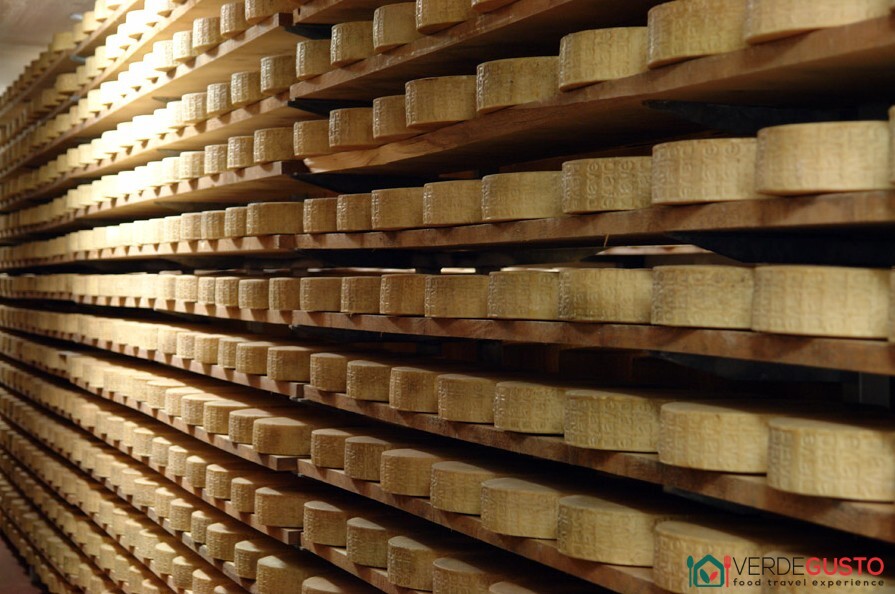
Piave DOP cheese is produced following the ancient rules of cheese-making tradition, now gathered in a “Production Specification,” updated in 2020, which requires the use of cow’s milk produced – for at least 80% – by selected heads of the breeds Italian Brown, Italian Red Pied, Italian Holstein e Alpine Gray, coming exclusively from farms in the Province of Belluno, where both the milk collection area and the production area are defined by the Regulation of the Specification. The cows are raised, where larger and better-equipped barns allow it, in free-stall housing and, in some cases, with summer grazing; the cows feed on the typical polyphyte meadow forage responsible for the cheese’s aromatic structure.
Besides the quality of the milk (breed, farm, origin), all stages of the production process – from pasteurization to aging – as well as the composition and individual recipe of the local cheese-making tradition, are fundamental in determining the distinctive characteristics of Piave DOP. The 2020 revision of the specification aims to accommodate requests from some realities such as mountain huts and small mountain dairies that do not have the possibility to pasteurize milk. Thanks to all these factors and the quality of its raw materials, Piave DOP cheese has obtained the Protected Designation of Origin, the highest recognition from the European Community for a quality food product.

Nutritional value of Piave DOP
Whether fresh or aged, it is made with natural ingredients, consisting essentially of fresh milk, lactic ferments, rennet, and salt. Piave DOP cheese contains essential amino acids, calcium, and phosphorus, and is easily digestible because during aging biochemical modifications make fats and proteins easily assimilable. In Piave DOP cheese, lactose is present in very low concentrations as it has been degraded by fermentative processes.
Types of Piave DOP: aging stages
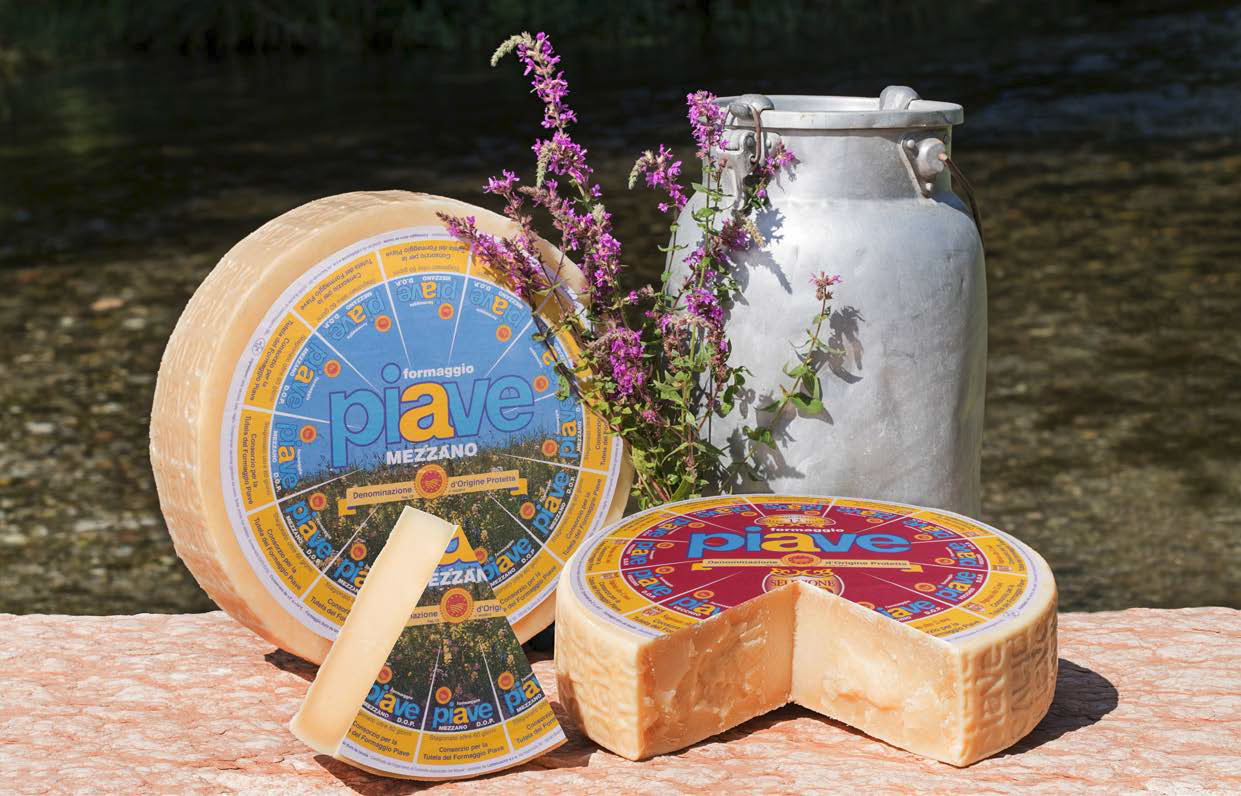
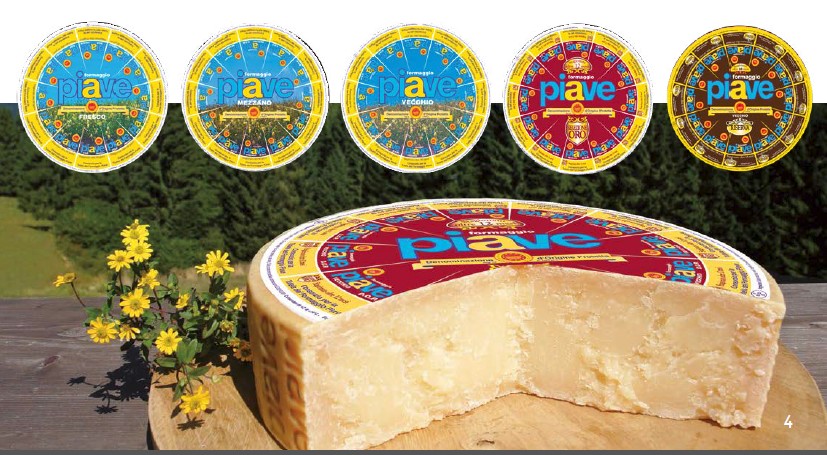
With its typical cylindrical shape, with a diameter of 27/32 cm and a height of the wheel’s edge of 7/8 cm, Piave DOP is a cooked paste, hard cheese, offered in five different aging types:
- Piave DOP Fresh (20/60 days)
- Piave DOP Mezzano (61/180 days)
- Piave DOP Old (over 6 months)
- Piave DOP Old Gold Selection (over 12 months)
- Piave DOP Old Reserve (over 18 months)
Piave DOP Protection Mark
Piave DOP is protected by EU regulations regarding food safety, traceability, authenticity, nutritional and health aspects. Products bearing the DOP mark represent the excellence of the European Union’s agri-food production and each is the result of a unique combination of human and environmental factors, characteristic of a specific territory.