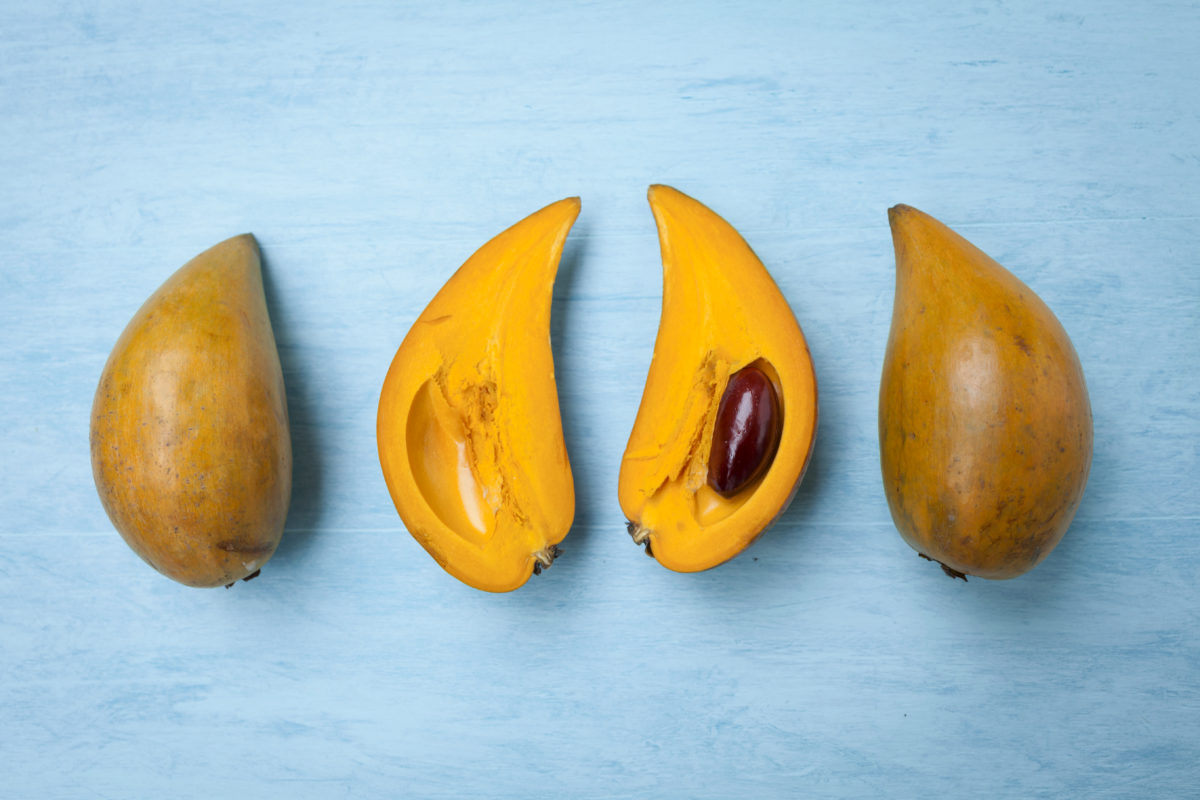
Lucuma is a fruit, although you won’t often find it in this form. Instead, it is becoming easily available as a powder or as a superfood added to smoothie blends. In its original form, it resembles a mango with golden pulp that tastes somewhat like a sweet potato. The texture is similar to a hard-boiled egg, from which its secondary name derives, egg fruit.
It is a plant native to the Peruvian Andean valleys, belonging to the Sapotaceae family, which has also spread to other Andean countries, while it is rather rare elsewhere. It is also cultivated in central Chile, characterized by a Mediterranean climate, so it is a fruit whose cultivation can be attempted in southern Italy. In Peru, where it is more commonly found, lucuma is greatly loved and used as a sweetener.
Benefits of lucuma
- Lucuma is rich in antioxidants that fight cancer.
- Lucuma has significant levels of beta-carotene.
- Lucuma is rich in fiber.
- Lucuma has a low glycemic index and can be used instead of sugar: it tastes like maple syrup.
Due to its high starch content, the pulp is sometimes dried for preservation, producing a very sweet and nutritious flour, containing iron, beta-carotene, and niacin. It can be stored frozen. Try adding it to smoothies, soups, yogurt, cereals, or almond milk.